Friday, August 04, 2006
Another use for alpaca geldings?
http://www.orthodoxanarchist.com/2006/07/alpaca-warfare.php
Just in case you thought alpacas were all love and fuzz.
m
Cria update #2
TLC seems to have worked! It took him until Thursday to begin acting like a normal baby alpaca; that is, doing some running, nibbling on leafy things, and going on exploration missions away from mom.
He was able to cush upright with his head up without shaking by Tuesday night. Before he would topple over and then just give up and sleep all stretched out. The vet was very worried when he saw the cria on Sunday because the baby was practically unresponsive until we walked up to him and picked him up.
Now the baby fights us when we pick him up instead of hanging limp. This makes it somewhat difficult to weigh him since he messes up the reading on the hanging scale when he kicks. We are certainly not complaining, though. Better to have an inaccurate weight due to kicking than an accurate reading due to lethargy!
I am no longer deeply worried about this little boy. I think he's going to make it. We still have a couple days of antibiotics to get through, but I am very pleased with his progress so far.
Now we just need a name!
m
Sunday, July 30, 2006
Cabernet cria update
Here are the statistics:
Dam: Cabernet
time: 4:40 pm
time standing: 6:40 pm
time nursing: 7 pm
weight: approx 16# (our scale is inaccurate and our new scale hasn't arrived yet)
We called the vet this morning because the little guy just wasn't vigorous. Normally, crias are actually running around by the time they are a few hours old. This little guy is still tottering around unsteadily when he isn't sleeping in a coma-like state. The vet couldn't find anything obviously wrong with him, so he put him on a course of antibiotics just in case and give him his vaccines. If we're worried about him not eating enough we are supposed to milk (!) Cabernet (surprisingly, she lets us do this) and feed him with a syringe, but I think he's nursing enough that we won't actually need to do this.
Cabernet delivered this cria at 11 months, instead of 11 1/2 months, just as she has for the previous two crias. Also, like the last cria, she delivered this little guy in the evening, not the morning. She just has to be different, but at least we've identified a pattern.
We hope that a little extra nurturing will give the little (as yet unnamed) guy a chance to catch up. It's all we can do for now.
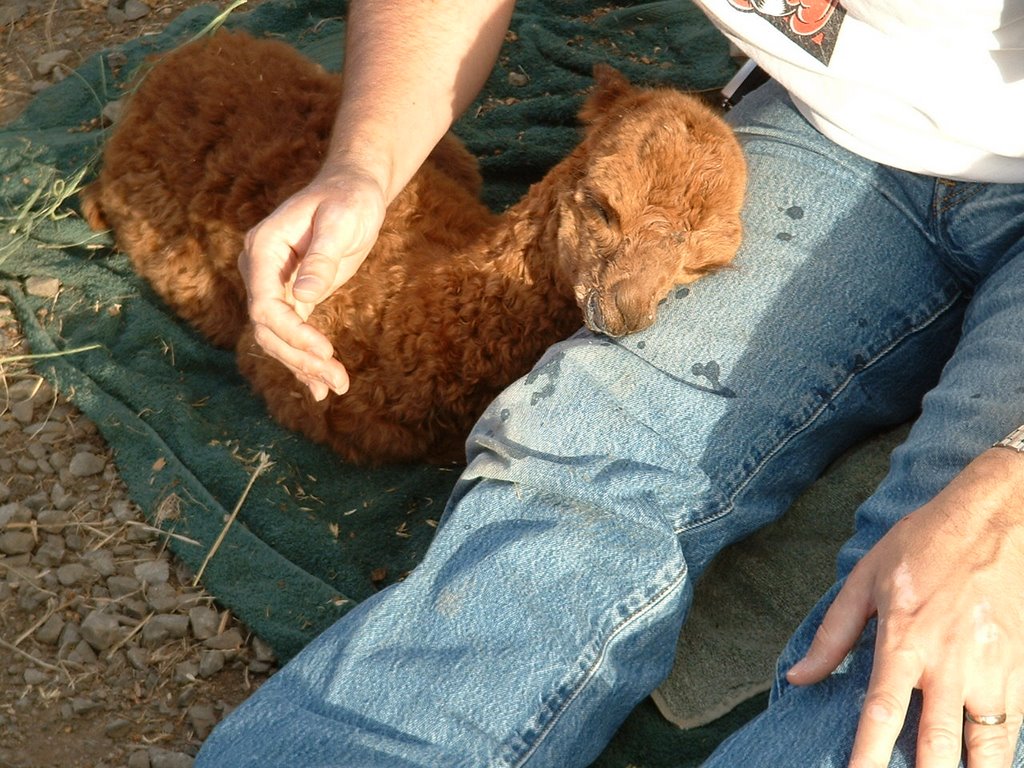
But he is extra cute. This picture is of him taking a nap on Charles's lap after we fed him some of his mom's milk with a syringe last night.
:)
m
Saturday, July 29, 2006
Cabernet's Cria
Tuesday, July 18, 2006
Four weeks to go!

Oh, so pregnant alpaca!
Cabernet is due in 4 weeks, August 13th. The last two years she's had her babies two weeks early, so we are going to begin watching next week, even though "cria watch" traditionally begins two weeks prior to the due date.
You can see in this picture how low she is carrying the baby. Usually, her tummy is tucked way up above her knee. It is now approaching her knee, and may be below her knee when she is close to her due-date.
So funny. So fat alpaca.
m
Thursday, July 06, 2006
Alpaca Wethers as livestock guardians

This article is about using alpaca wethers (gelded males) as livestock guardians in Australia. I had a phone call a few months ago from someone on the East coast asking about using alpacas as guardians because someone on her farm was afraid of llamas because of their size. I told her to buy two alpaca geldings and use them together as guardians.
The main problem with using alpacas as opposed to llamas as guardians is that alpacas are at a size disadvantage. However, most predators will back away from a challenge, and my alpacas (even my pregnant girls!) will challenge stray dogs and coyotes. The advantage may be in numbers, however. I still recommend that people get two alpacas because they don't seem to bond to other livestock the same way that llamas do and get lonely without another alpaca. However, according to the article, they still bond to the flock and will protect it.
I think this is a great use for gelded males who might not have the best fiber, especially the assertive ones. I am certainly going to use this article as a marketing tool for my fiber males.
m
Friday, June 30, 2006
Six weeks to go!
Cabernet has had trouble with her last two babies so we have all our fingers and toes crossed for luck that she will carry this little one to term and deliver it without assistance. She deserves to be a mommy again.
That said, she is being a righteous b**** at the moment. She tries to steal food from the other girls and hogs the hay bin whenever she can. We try to excuse her by saying that she is pregnant and hot, but really, Cabernet just likes to be boss, and so she is bossy and demanding, even when she isn't pregnant.
I can't wait to have little cria bouncing around again! They are sooo frigging cute.
Pray for girls.
maren
Friday, June 23, 2006
baby pool
Tuesday, June 20, 2006
shearing update
The excitement came when we were shearing little Snowball, a.k.a. Ringo. He was cut by the shearers. He didn't even flinch, but the rest of us were very upset. We closed the wounds with superglue (it's what it was designed for, you know), and slathered triple antibiotic ointment on it. It is now healing fine.
I need to get an "after" picture of Snowball up. He looks even less like his "before" picture than the fuzzy alpacs do.
m
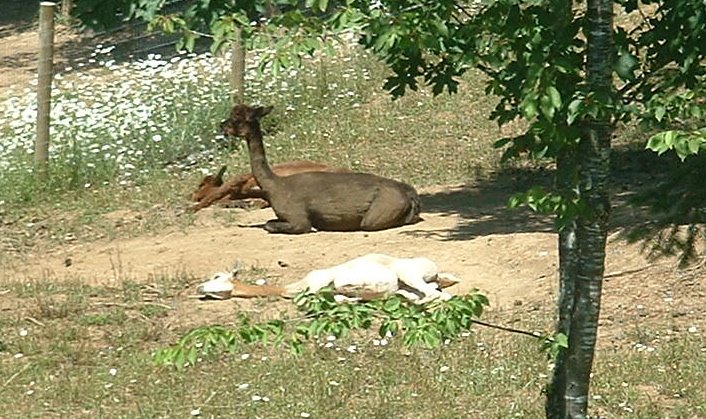
What happened to these 'pacas??

What happened to these alpacas?
Actually, they are sunbathing. The first couple times you see this out your window, you go rushing out thinking that they are dead. They sit up when you get close and look at you expectantly. "Well? What did you wake me up for?"
This also demonstrates what the weather is like here. We only have a few more hours of "Spring," which is nice because it has been rainy and cool here since one freak weekend in May when it hit 90 degrees. Now it is 70 degrees with the promise of summer-like 80s next week.
When it gets that warm, the alpacas seek out the shade. I also fill up the baby pool for them. They love that so much that they fight over it. I'll have picutures, I promise.
m
Thursday, June 15, 2006
Pre-shearing Pictures
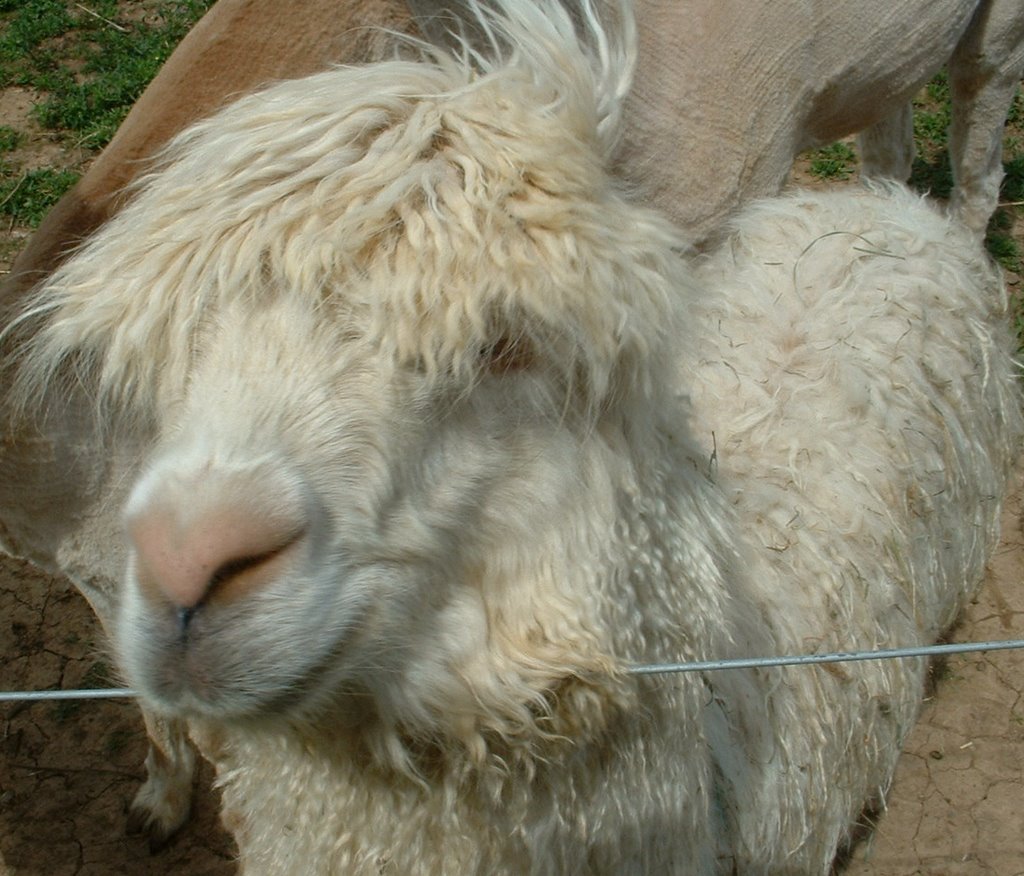
I'm just preparing for Saturday when our final three alpacas will be shorn. This is our only suri alpaca. Notice how his fleece is twisted and stringy, not fluffy like the other alpacas. This is a genetic variation that is actually a dominant gene, but suri alpacas were nearly wiped out by the Spanish sheep hundreds of years ago because they can't stand the cold as well as their huacaya cousins.
The other two to be shorn are Dawn and Consuella, both of who are due in September. This is a little late to shear them, but it is still a week earlier than we were going to shear them originally.
Alpaca pregnancies are a little delicate the first three months and the last three months of an 11 1/2 month term. They are pretty solid those middle six months, but immediately after breeding and approaching delivery, you don't want to stress the mammas. They can and do re-absorb pregnancies during the first three months and they can abort during the last three months. This means that we like to get stressful things like shots and shearing done in that six-month window, or do it between birth and re-breeding (about a 2 week window).
We're pushing it with Dawn and Consuella as they are due between 10 and 12 weeks from now. I think it will be okay, though, since both of them have had many unproblematic pregnancies.
However, I am going to be far more vigilant in the future to schedule shearing in May when all of the girls will still be in that six month "safe zone." I'll sleep better at night if I do.
In other news, Cabernet is due in eight weeks. This means that cria watch will begin approximately the last week of July. This might be a problem with filming the movie this summer, but we'll cross that bridge when we get to it.
That's all for now.
m
Thursday, June 01, 2006
Fleece show Update!

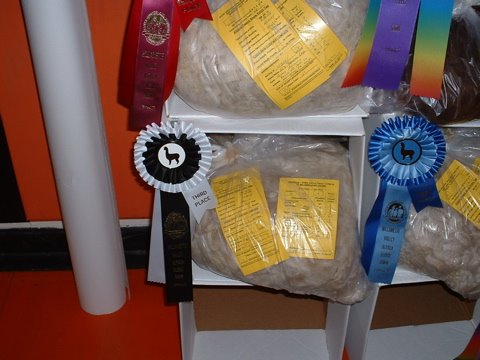
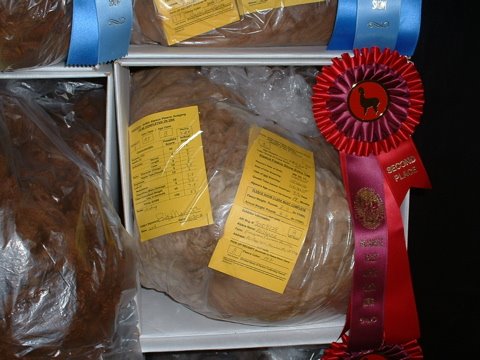
This is Duffman's Fleece. He won a 3rd place ribbon!

This is Milhouse's fleece. He won 2nd place!

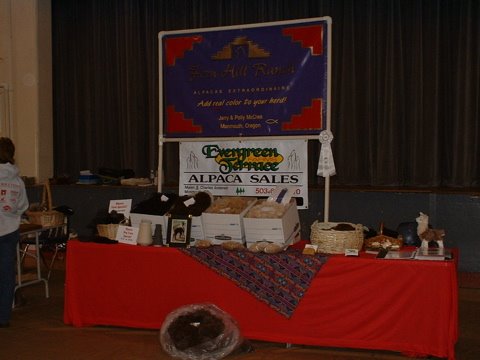
This is our display. I shared with Polly from Fernhill Alpacas.

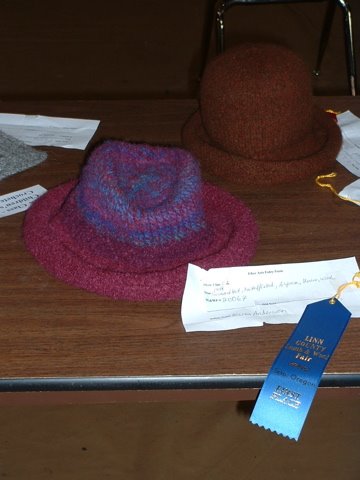
This is my entry in the fiber arts contest. I won 1st place!
It was a good show for ribbons, but I didn't sell a blamed thing. Oh well. I'll pick the fleeces and send them off for processing.
I'm thinking of using the black yarn from Tony for myself. I'm thinking shawl.
ta
m
Tuesday, May 16, 2006
Skirting table

As you can tell, I've figured out how to post photos to this blog.
Above is a shot of my skirting table in our embarrassing skirting room (a.k.a. spare bedroom). Notice the TV where I can watch my "stories" as I mindlessly pick poop, vegetation and bib hair out of fleeces.
The skirting table is made out of hardware cloth and plastic pipe. I can send the plans along to anyone who wants a copy.
That's Milhouse's fleece on the table there (the naked critter in the previous blog). That is his blanket fiber, which we are entering in this weekend's Willamette Valley Alpaca Fleece Show http://www.sciolambfair.org/alpacashow.htm
It is associated with the Scio Lamb and Wool Festival, which has a sheepdog trial, too. I'll be there with a booth with other fleeces for sale and some yarn.
I am entering El Barto's, Duffman's and Milhouse's fleeces for this year. Since we only had them sheared on 5/6, I've been picking these three fleeces pretty furiously. I should estimate how long it takes me to pick a show fleece someday. Usually, I spend a couple hours on each before I get disgusted and give up.
I've only got three more days (two really) before I have to turn the fleeces in.
m
Monday, May 08, 2006
Saturday, May 06, 2006
shearing
Alpacas do look silly when they've been shorn. Milhouse in particular looks ridiculous without his fluff.
It's a good thing their feelings aren't hurt when you laugh at them.
Or maybe they are hurt. They just look so sad when they are naked that it is difficult to tell how they feel.
hee hee hee
maren
Sunday, April 30, 2006
Shearing in a week!
1. Cabernet will be too close to her due-date to shear in June. She is due in August, and has had a history of having trouble in late-term pregnancy. We will be far more comfortable shearing her three months out than two months.
2. There is a fleece show in Scio, OR, the third week of May. I'd like to have the boys' fleeces for the show, but our original shear date wasn't until June. Polly is going to bring her boy over to be shorn for the show as well.
The bad news is that I haven't been working with Duffy on the halter nearly enough. I put one on him for the first time today. He was pretty good about it (Barto was, too, when he was a baby), but I need to work on Milhouse as well, especially since he was such a stinker at the show.
It will be a very interesting shearing because the shearer is going to use a table: This thing swings up vertically, then you strap the alpaca to it, then you flip it horizontal, then you shear them lying down. None of the animals have seen one of these before, I think. It will be weird. :)
m
Wednesday, April 12, 2006
Heart of the Valley wrap-up
However, we did have some good times, make a movie, and sell an alpaca. I have to say that it was a successful show!
Some friends of mine (all college professors or librarians) decided to enter a documentary film contest (I'll add the URL to the contest soon). The contest allowed competitions 4 1/2 days to make a 4-8 minute documentary, but they would give us a topic and a "theme" at the beginning of the contest to keep people from starting early. We brainstormed ideas before the contest, and I brought up the alpaca show. My friends love our critters, and we decided that, if we could, we would shoot the documentary at the HOTV show.
The topic turned out to be "sports" (if dog shows are a sport, so are alpaca shows!) and our theme was "freedom" (so we shot pictures of the critters running "free" across the field). The crew shot some footage at our farm the day before the show, took shots of us loading the boys up in the trailer and shots of the show set-up on Friday, and then spent most of Saturday at the show filming and interviewing people. They spent Sunday editing. I was still at the show.
They finished the film and mailed it off on Monday. I have a copy for ETF and one for WABA. I think the film is great. They focused on the fact that alpacas are "flight animals," and so this whole show thing is a little bit of a strain for them, and unnatural. I'll be showing the film at our WABA meeting on Thursday.
The other good news from the show is that we have sold Tony! If you remember, Tony is the replacement alpaca that the previous owners of Cabernet gave us when her baby died last year. Actually, we picked him up at last year's HOTV show! Anyway, the people who have bought him bought another male from another farm, too. They just wanted some pets for their kids. They have some land outside of Corvallis, and four little red-headed children. I think Tony made the sale when he let each of the kids (except the 2 year old) lead him around on a halter. He was so curious about them and gentle. I suspect he is going to be a 4-H project or something someday.
We didn't get as much money as we wanted for Tony, but I agreed to the price on the condition that we get this year's fiber off of him. They were perfectly happy to do that. The yarn we had made from last year's fleece was so nice that I have been looking forward to this year's fleece for a while.
So, it was a good show. Tony's sale just about covered our costs if we don't look at them too closely. Yay!
Monday, March 20, 2006
The Show List
- feed--hay, pellets, water bucket
- grooming--whack-it
- poop--small broom (better on the mats than a rake)
- fiber for fleece show--picked and bagged
- halters and leads
- yarn (if it is back from the mill)--lables, reciepts, display, sacks
- fiber for sale--lables
- folding chairs, snacks, photo/ribbon album, corkboard (for display)
- sheet protectors, information sheets on animals, zipties, banner, cards
- showbooks (I made them this year)
- decorations
We also have to arrange with another alpaca owner to take our alpacas to the show because both of us have final exams to give on Friday. Oh well.
Gotta go!
too much to do
m
Thursday, February 23, 2006
new WABA website
http://www.alpacas-waba.org/
It was a lot of work, but I think the site looks really good. Also, check out the sales pages and herdsire pages. WABA members get to post their animals on these pages for no charge (beyond membership dues). Sweet deal, huh?
m
Tuesday, February 14, 2006
An Escape!
First, it is not for horses because they can get tangled in the wires, freak out, and do serious damage to themselves.
Second, alpacas can escape.
We have seen this escape three times, but I am convinced all three were accidental, and none of the alpacas involved actually know what happened. This is what I think has happened: The alpacas love to roll in the dirt (or mud, whatever), and in their vigorous rolling, they get their feet, then their heads outside of the fence so that when they stand, they are on the other side! They always seem as surprised as the rest of us when this happens.
Our biggest alpaca, Cabernet, has done this twice, and both times I'm sure it was accidental. The most recent escape was on SuperBowl Sunday, when Charles, my mother and I went outside during a commercial to put the alpacas to bed quickly. Naturally, that was when we discovered Cabernet on the wrong side of the fence, very much wanting to go into the barn to get her treats. We are fortunate that alpacas are very herd-oriented because I have no idea how long Cabernet had been outside the fence before we found her. If she were a horse, she could have been miles away by the time we noticed.
We finally caught her and put her away after only about ten minutes of chasing. Thank goodness we took the time to halter-train her!
We had heard stories about cria accidentally rolling out of New Zealand fencing, so our maternity pasture has 2x4 woven wire fencing. But we never thought a big alpaca could pull the same stunt!
This probably won't be a problem once we get the fence electrified. I suspect it will only take a couple zaps before all the alpacas avoid the fence completely. But take it from me, New Zealand fencing is not secure for alpacas. They can get out, and I wouldn't put it past a smart one to figure out how to do it if it happens to him once or twice.
That's all!
m
Thursday, February 02, 2006
We're famous, and we're upgrading
The sidebar feature talks about our little farm and how we became involved in alpacas. I was interviewed last September for this, but the magazine has only just come out. I have to say that I now hate the picture I sent them, but what are you going to do? Anway, I have had two responses since the magazine was mailed yesterday from other Holyokers who have alpacas or are going to get some soon! How fun!
In addition, I am finally upgrading our website so that it looks more professional. Partly this is because there will be more traffic on the site now that we have been featured in a national magaizne, partly because I am done tweaking it. If any of you find mistakes, please let me know a.s.a.p. I think I have checked all of the links, but I may have missed something. Check us out again at http://www.et-farms.com.
ta
maren
Sunday, January 29, 2006
Wetness
Other than that, we are gearing up for the show coming in March. I am putting together the showbook for the Heart of the Valley Show on March 25 and 26, which happens to be the weekend after finals week this year. At least the show will be over before spring break so we could actually relax a little. We are taking Barto and Milhouse, but we may also bring Duffman, who will just be old enough to compete. I don't have his registration yet, and I can't enter him until I do, so we'll see. He has such gorgeous fleece.
Finally, I am finally putting together a lot of fleeces to be spun by Starcastle mill in Washington. I am picking the last of the fleeces, and I'll throw them into the mail when it is done. I am hoping to have the yarn back before the HOTV show! Wouldn't that be great? I am very very excited. :)
ta
maren
Thursday, January 19, 2006
Quarantine is over!
Now everyone is well and we can put them into adjoining pens again. They like to sniff and say hi.
The stall the girls are in is still a soupy mess, but it is better than last winter. Also, they now have two stalls to roam in, so there is a dry spot for everyone to sleep on.
In other news, I am in the process of taking all the entries from 2005 and re-writing them into a book. That is a big enough project to keep me off of the streets for a while. :)
m
Tuesday, January 17, 2006
The Alpaca Breed Standard
First of all, I’m not sure that we need a breed standard. Breed standards are useful in dog shows because they need to ensure that their animals are pure. ARI registered alpacas in this country are all DNA tested and their parents are registered and have been DNA tested. There is no reason to question the “purity” of registered American alpacas.
Second, if we accept that the ultimate goal of alpaca breeding is to create animals that are conformationally healthy and will produce ample commercially viable fiber. It has been shown that great fiber can come from any phenotype. That is, some very ugly alpacas can produce some very great fiber. What this means is that a breed standard which focuses too much on aesthetics may not contribute to the breeding of great fiber animals.
Third, let’s say that AOBA adopts a breed standard that favors a certain phenotype: for giggles, let’s say that the alpaca standard calls for a long, goat-like beard. Very few alpacas would show this trait, but those that did would instantly increase in value. In addition, everyone would want to breed to these animals in order to get the genes for this beard-trait into his or her own herd. What this means is that, because of the demand for the genes of these rare animals, many animals would be born that would be very closely related to each other. Alpacas have a limited gene pool in the first place compared to say sheep or cattle, and further limited their genes would make them far more susceptible to disease. Cheetahs have been held up as and example of what can happen to species with limited gene pools. With our closed registry, it seems like a very bad idea to further limit our animals’ genetic diversity for purely aesthetic reasons.
Some breed standards that are based on aesthetics are harmful to breeds. Take, for instance, English bulldogs. English bulldogs have been bred to have such big heads that the animals cannot give birth naturally; they must have Caesarian sections. These animals cannot reproduce naturally because of an aesthetic trait that humans appreciate. This is a not-so-extreme example of how aesthetics can overshadow the useful traits of the animals involved.
Part of the fear that small farms have expressed about the breed standard is that large farms who have a “trademark” phenotype will try to get that phenotype written into the breed standard. All joking aside, let’s take the Accoyo head as an example. I must admit, I love the look of the Accoyo head, with the fuzzy cheeks and fluffy topknot. However, this is a phenotype. Don Carlos calls it his “trademark.” The fuzzy cheeks and fluffy topknot are not the sole indicators of an animal with dense, fine fleece. This is an aesthetic characteristic. Period. There are people who breed almost exclusively for this type-y head. But because their animals have fuzzy cheeks does not mean that they have animals with great fleece. If an Accoyo head become part of the breed standard, though, then those animals become more valuable, and other breeders are left out in the cold.
I have identified two pros. First, an alpaca breed standard could make judging at shows more uniform. With a clearly-written standard, animals would be judged based on the standard, not just compared to other animals in the ring. Also, a breed standard could be used as a tool for breeders to evaluate their own animals, or for buyers to evaluate animals they are considering buying.
Second, if we accept the thought that the goal of alpaca breeders is to create animals that have good, healthy conformation and can grow abundant fiber, then we can design an American Alpaca Breed Standard that is reasonable. The Canadian Alpaca Breed Standard is pretty bare-bones, but it is a good start. It simply gives a description of correct confirmation and fleece type. There are no aesthetic attributes.
All in all, I am opposed to any but the most basic of breed standards. We don’t need to define different breeds since we have only two very distinct varieties of animals, I think there is a high probability that aesthetic characteristics will become the focus of the standard, and limiting the already small gene-pool that we have is a dangerous thing. Those are my thoughts. Please see the websites listed below for further information on the Alpaca Breed Standard.
References:
Canadian Breed Standard: http://www.wakefieldalpacas.com/Breed%20Standard/breedingstand.htm
Comparative Analysis of Breed Standards: http://www.alpacas.com/AlpacaLibrary/ComparAnalyssBreedStandard.aspx
Tears of an Alpaca: http://www.gateway-alpacas.com/alpaca-breed-standard.php
Friday, December 30, 2005
Everybody is home!
On Christmas Eve we went to our neighbor Polly's place (Fernhill Ranch Alpacas) to pick up Cabernet, who has been there since October because she was lonely at our ranch without her friends. She seems glad to be home with her girlfriends.
We have quarantined all of the returnees in a stall out of spitting distance from the boys because all of them have come back from farms with known coccidia problems. Even though only Dawn was ill with it at NWA, we are treating all of them on the recommendation of our vet. This is because coccidia establishes itself in the soil and then becomes a recurring problem. We hope by treating them all, we can keep this parasite off of our ranch. At the moment we are treating their water, but once we get some minerals delivered, we'll treat that as well.
One difficulty with our quarantine plan is that the far stall where the girls are is wet. We have had a lot of soaking rain in the past couple weeks, and that stall is the lowest point in the barn. Even though we put gutters up this summer, the stall is still a muddy wet mess. It breaks our hearts to put them in there every night, but we're stuck for another week of quarantine. After that, we can move them into stall #2, which doesn't have the wetness problem. Next year we ARE going to put in a drain around that side of the barn; the gutters are obviously not the solution to this problem.
I hope everyone had a Merry Christmahanakwanza, and a Happy New Year!
maren
Wednesday, December 14, 2005
Everybody’s Preggers!
Not only is Consuella pregnant, but she’s been pregnant for 75 days! Yes, that means that she has been pregnant since approximate September 30. She’s acted pregnant because she HAS been pregnant. I do not know how to explain the inconclusive ultrasounds, or the negative progesterone, but the veterinarian saw a 2 1/2 month-old cria when he ultrasounded her on December 12. So, she knew all along, and kept telling us.
So, we will go pick up the three of them (Dawn, Duffy and Consuella) sometime before the first of the year since we are on break. Then we can bring Cabernet home as well.
First, however, we have an appointment with Dr. MacGuire tomorrow to talk about quarantining them once they are back on the farm. Dawn’s bout with coccidia during her stay at NWA makes it necessary for us to keep her separate, but we are going to keep everyone that’s been off the farm separate d for a while. Cabernet is currently on a farm where a young cria seems to be battling coccida , too. Dr. MacGuire will help us make up a solitary confinement plan.
It will be so nice to have the girls back on the farm! I am looking forward to having a full barn again. Plus, we haven’t seen Duffy since he was three weeks old! He is now three months old, nearly the same age as Bart when we brought him home! We’ll have to start working with him on halter training. If he’s nice enough, we’ll take him to Heart of the Valley with the other boys.
Awesome news.
Monday, December 05, 2005
We’re pregnant!
We think Consuella is pregnant as well. She finally settled for Haldane last month (see the previous blog entry). If she is pregnant, we can get her the week after Christmas. If not, we may have to hold her over until spring. I really don’t want to do that, but having babies in November is not such a good idea, first from a weather standpoint, and second from a last-four-weeks-of-the-term standpoint. If we hold her over, though, she will have been open for a year. That’s a huge waste of money (a whole cria could have been made in that time).
If Consuella is pregnant, we’ll probably get the two girls at the same time at the end of December. If she isn’t, then we may get both of them anyway to take them home for the winter.
Keep your fingers crossed.
The other news is that while I was sick for two weeks this month, Charles taught Milhouse how to eat pellets! This means that we no longer have to give him a daily dose of carrot toothpaste, which is what I called the vitamin paste we were giving him. It’s kind of a shame because he was beginning to enjoy the contact (I think). However, he LOVES his pellets now. He’s like a little Hoover. Vrooom. Now we’ll see if the added nutrition straightens his legs out any.
Wednesday, November 09, 2005
Breeding updates
Well, the good news is that Consuella, who has not bred properly since August, was observed breeding this week (finally)! Her reproductive workup proved normal, so I hope that the male was to blame. She might just be particular about whom she "sleeps" with, so to speak. Anyway, we should know in a week or two whether she is pregnant this time. This means we'll have an October baby, which I don't really want, but it's better than no baby.
Dawn recovered from a bout with a light case of coccidia last month, which seemed to mostly give her gas. She ought to be ready to come home around Thanksgiving. I'm looking forward to having all the girls home, but we won't be seeing Consuella until nearly cruising.
Cabernet is doing fine at Polly's ranch. She'll stay there until Dawn comes home. They aren't the best of friends, but they will do for company for each other. By the first of the year, the whole happy herd will be back!
This experience makes me feverently hope that we get a stud out of one of our boys soon. At the very least, I'm sorely tempted to use local studs next year. I want my critters on my farm. I bought them because I like them, and I like taking care of them.
The boys are fun, though, and can be challenging. For instance, for some reason, Tony has become a bully. Even though we had two food dishes and two buckets of hay, he still had to harass Bart and Milhouse while they tried to eat. We now separate Tony from them at night by putting him in an ajoining stall. Everyone seems happier for it, and the hay buckets aren't overturned in the mornings.
It is now officially cold here, with the temp this morning a chilly 28 degrees. The alpacas love it.
m
Monday, October 31, 2005
Cabernet at camp
briefly, Cabernet was unhappy at home in a field by herself. Even though she could see the boys, she would pace unhappily at the fence when they weren't near. When they were near, she would spit at them. We have taken her to Polly's alpaca farm (Fern Hill Farm) to spend some time with lots of alpacas until Dawn and Consuella come home.
Consuella is having trouble getting pregnant. More on that later.
Dawn had a mild case of coccidiae at NWA, and they took her to the vet and treated her. She is apparently bred, and just needs a few weeks for the pregnancy to set. Duffy seems to be in fine form.
I'll go into details later, but I wanted to report that we are again down to three alpacas on the farm. Ah, the drama!
maren
Saturday, October 22, 2005
Milhouse's paste
We are going to start giving Milhouse vitamin paste to try to treat his crooked front knees. Because he has never tried to eat pellets, his nutrition is dependent on the hay and forage we've had him on, so we are worried that he has rickets. Because alpacas are native to the Andes mountains, they are designed to get their vitamin D from sunlight through a very thin atmosphere above 10,000 feet. We are at 400 feet. Maybe you can see the problem.
Anyway, the pellets designed by WABA breeders makes up for the sunlight deficiency by adding the vitamins to the feed. This usually works for all those alpacas that actually eat them. I am sure that all of us (Charles, me and Milhouse) will soon be very tired of a daily dose of paste vitamins, so I am devising plans on how to get Milhouse interested in eating them. Mostly I think he is just not interested in competing with the other alpacas for pellets (I think they are sweet because the alpacas will fight tooth and nail for them). One strategy I am considering is to lock him in the middle stall by himself (he will see the other alpacas) and leave him with only a little hay but a lot of pellets overnight. That might do the trick. I hope it is that easy.
Still no word on Consuella's progesterone, but at least Cabernet seems less stressed. We have put her into the antechamber, which used to be the boy's pasture. It is greening up nicely, and she has a little more room to pace around it.
maren
Tuesday, October 18, 2005
Cabernet is back
Unfortunately, she is the only girl here, and she isn't very happy. She doesn't like to be in a pasture by herself, but she ignores the young male alpaca when we put him in with her. We can't let her out with the older male alpacas because we think they would harass her to distraction. So, she paces the fenceline and stares off into the distance, I think at the neighbor's dogs (which aren't out most of the day). I will be SO happy when we have a Consuella back for her to be with. I am so concerned about this, though, that I am considering asking another farm to loan us an female alpaca or gelding to put in with her so she won't act so weird. Either that, or I may ask another farm to baby-sit her until we get more of our own girls back.
Consuella has had two negative ultrasounds, but she spits off at teaser males. I have asked for a progesterone test, which should come back this week. If it is postitive, we will bring her home very soon for Cabernet, and give them both Ultrasounds at 90 days, when there might be more to see. If the test is negative, my options are to re-breed her to Canadar, or pick a different stud. I'm mulling that one right now.
Well, off to put the alpacas away!
maren
Wednesday, October 12, 2005
New Chicken Coop
Now that the boys are on P1, we have taken the chance to re-seed their pastures--the antechamber which will be re-fenced into runs to the new pastures in the spring. They have nibbled everything down so far that there isn't even any poison oak or blackberries left. We have also re-seeded P0, our maternity pasture/chicken run. We know that the chickens will help themselves to the grass seed, but they won't get all of it.
On the topic of chickens, we finally finished the chicken coop! It took us about three weeks of picking away at it to finish, but now we have moved the 1/2 grown hens outside. The roosters don't quite know what to do with them. They are like teenage boys with nine year old girls. We expect some scuffles in the future.
We are still waiting on word about Consuella's pregnancy status. I am a little annoyed that the vet has not performed a progesterone test on her yet, since that seems to be the next logical step if the ultrasounds are inconclusive. She ought to be nearly six weeks pregnant, and if she's not, I want her re-bred NOW. Dawn and Duffy are up there, and I'd like an update on them, too. I now sign my notes to them, "the squeaky wheel."
When you send your animals away to a big farm to be bred, you sometimes have to pester them to get information. Don't be afraid to be a squeaky wheel. It's better to be a bit of an annoyance than to miss out on an situation that needs to be taken care of sooner than later.
That's all for now!
m
Sunday, October 02, 2005
Lonely little farm...
The only alpacas we have on our ranch currently are the three boys, Barto, Milhouse and Tony. We were concerned about putting Milhouse in with the big boys, be he seems to be doing all right. We put him in with Barto yesterday just so there was less chance that the bigger boys would gang up on him. He and Barto got along pretty well when they were alone. Now Barto and Tony are playing, and poor Milhouse stands by the sideline like a little brother who doesn't get to play. Poor baby.
We have let the boys into Pasture One (P1), where the girls usually are. Now that it is raining (hard) here, their pasture is nothing but mud. Between the dry summer and their overgrazing, that patch of land was nothing but hard packed dirt for the last two months. We'll seed it and P0 while the girls are away. The boys love P1 since it is twice the size of their normal digs, plus, it has actual green stuff in it!
Charles has been working hard prepping what will be Ps 2 and 3. A week ago we had someone come with a dozer and push the burn pile out of the way and scrape the land so that it didn't have weeds and huge chunks of wood on it anymore. When Charles realized that the dirt was suddenly perfect for seeding, he hurried to buy the seed and fashion a "rake" out of a chunk of chain-link fence and a t-post to drag behind his lawn tractor. He finished a full 24 hours before the current deluge of rain came. He's so sexy when he's handy.
That's the quick update from here. We might get one of the girls back as soon as the last weekend of October, but mostly we are going to miss them until November. So sad. Next year I'll be using local studs, that is for sure!
Wednesday, September 28, 2005
Pregnant!
We are awaiting new ultrasound results for Consuella, so no news on her yet. She has been spitting off the males for a couple weeks, however.
Dawn and her baby (christened "Duffman" by birthday party goers on Sunday) will go to NWA on Sunday for her breeding to Patacuti.
After that, it will be a little lonely on the farm because the only alpacas we'll have will be the three boys. Milhouse will have to learn to get along with Bart and Tony until his mother comes back. The good news is that the boys will have the run of the place, so they don't have to be in their barren pasture anymore.
In other news, we had a birthday party for me/welcome little alpaca party on Sunday, Sept. 25, where we had a naming contest for the alpaca and the new kitten we found by the side of the road.
Finally, we have had two more acres cleared of forest, and Charles spent yesterday purchasing grass seed, and will spend today spreading it. We will fence in the spring after the grass has had time to establish itself.
Oh, yeah. School started for us on Monday, so summer is officially over for us. Boo hoo. And I still haven't hung up pictures or sent fiber to be processed.
maren
Saturday, September 10, 2005
Our new baby boy!
Dawn had her cria on September 9, but not without difficulty. When we found her in the barn, her baby’s head was out and breathing, but there were no little feet. Typical alpaca births are toes first, then nose. Charles ran to call the vet and Polly, our alpaca friend, and I lubed up and reached in to see what was going on (I’m surprised I did it, too!). I felt a pair of knees pushing up against Dawn’s hips, which meant that Dawn was not going to deliver the baby by herself.
By the time Polly arrived, I had fished out one leg, but the other was now back deep inside. Neither Polly nor I could maneuver it out, so we could only wait for the vet. By this time, Dawn was lying on her side moaning, and the baby was making “Ow! Ow! Ow!” sounds. It was weird to see a two-headed animal making noises like that.
The vet finally came flying up our driveway at unsafe speeds with his gallon jug of lubricant. He reached in and in about two minutes produced another leg and then a whole baby alpaca! He made it look easy, but that is what we pay him for. It was such a relief to see the little cria out because Polly and I were very worried that even the vet wouldn’t be able to get that last leg out. I don’t even want to think about what might have happened if he couldn’t.
The vet was concerned enough about the difficult birth that he asked us to call the Vet School at OSU if the little cria wasn’t up and nursing by noon (he was born around 9 AM). The vet also gave us penicillin to give Dawn, since no fewer than three people had been working inside her. I have to administer this via syringe, so I gave my first shot yesterday! I am such a farmer’s wife.
I am glad to say that the little nameless boy was nursing by 11 AM, and was out of the barn exploring the nursery pasture by that afternoon. Today he was doing what we call “Speed Racer,” where he runs in ever-larger circles, all ending up back at his mom. Dawn is a fierce mother, and boy, does she have milk! The swelling around her vulva has gone down significantly today, too.
The picture at the website includes Milhouse, who is now 6 months old. His mother is off being bred at another farm, so he has attached himself to Dawn, who only barely puts up with him. Now, his place as the baby has been usurped by a much smaller baby, and he is sulking a bit. The next time I see him kick at the cria, though, he is going to find himself in the pasture with the bigger boys, who will put him in his place. I’m reluctant to do so because this has been such a bad couple weeks for him, but the baby must be safe.
Dawn and baby will be on our farm for the next three weeks or so, at which time we will load them up so Dawn can be bred at NWA. Come and see them while you can! They will be gone until Thanksgiving, which is hard for us. We will miss our little whatever-his-name-will-be.
Sunday, September 04, 2005
Ribbons and sex, sex, sex!
Our new ribbon!
El Barto has done it again! He won 3rd place at a confirmation-only show at the Oregon State Fair on Friday! We are very proud of him.
The show was put on by WABA, at the last minute. Someone in our association knows someone at the fairgrounds and was asked if we could use the brand-new pavilion at the fairgrounds for one day for free. They had a cancellation or something and needed to fill it. We jumped at the chance because the State Fair has built-in advertising and walk-in traffic that we would never be able to muster at an alpaca-only show. As it was, we saw lots of people who came in out of curiosity and left with our card and some information. I hope it is an annual event.
The only downside to the show was that I was sick as a dog with a head cold. I tried not to touch anyone and smile a lot, and I ran mostly on adrenaline. I am still suffering from the cold and feel wretched, but it was worth being sick a couple extra days to be there.
Bogart baby on the way!
http://www.alpacas.com/Studmaster/StudDetails.aspx?alpaca_id=69497
Dawn is due on September 5, (tomorrow) for a baby by the above stud. He’s a son of Hemingway, who is a magnificent stud, and father of many champions. We are on criawatch, which means that we are on the farm all morning, watching Dawn for signs of labor. She was a month late last year (or two weeks late, depending on how you count gestation). Either way, I don’t expect a baby for a week or so, but we are stuck here just in case. Most babies are born without incident, like Consuella’s baby in March. However, there is always a chance of a dystocia, or incorrect position of the baby. These can be bad, so we need to be here in case she needs help.
Right now, our other two female alpacas are off the farm being bred. Consuella is up at Northwest Alpacas, where we bought Dawn and El Barto, being bred to Canadar, a new stud that Mike Safely discovered standing idle in Canada. He is also a Hemingway son, and Mike is very excited about him. He can be found at the following link: http://www.alpacas.com/Studmaster/StudDetails.aspx?alpaca_id=2035. This was a last-minute decision, made at the farm as we dropped Consuella off because he was so handsome.
Cabernet is at Alpacas at Lone Ranch, where we bought her, being bred to Barolo, who can be seen at: http://www.alpacasontheweb.com -- go to “herd sires” and then to his page. She and he had their first date on Friday, and will try again on Tuesday, too.
About two weeks after Dawn has her baby, we’ll send her to Northwest Alpacas, too, and have her bred to Pachacuti http://www.alpacas.com/Studmaster/StudDetails.aspx?alpaca_id=178 , who we hope will add his denseness to her fineness.
So, once Dawn and her baby are gone, we will only have the young males on our ranch. It will seem lonely with only three alpacas all of a sudden. The girls will be gone approximately two months each because alpaca pregnancies can be delicate for the first couple months, and transporting them before then can turn a pregnant alpaca into a not-pregnant alpaca.
However, we will have the whole crew back by early November, with Dawn’s baby to entertain us through the winter.
Wednesday, August 17, 2005
Trailers and Breedings and Shows, oh, my!
The trailer was a big step for us because it is the biggest purchase we have made since we bought the alpacas. This is partly because the trailer is pretty specific. Our Subaru Forester, much as we love it, cannot pull a horse trailer, which is the default large-ish animal mover. The good news is that alpacas don't need to be hauled around in a horse trailer because they are considerably smaller than a horse. This means that we can get away with a lightweight cargo trailer that is about five feet wide and ten feet long.
Unfortunately, while there are many of those kind of trailer for sale used, since we propose to hauling live animals around in it, the trailer we needed had to have many windows and air vents. It could also not have formaldehyde-treated trim as it heats up and gives off chocking gas. Not many trailers with those specifications are knocking around Oregon used, I must say. So that meant we had the fun of going to a dealer and ordering exactly what we wanted. Anyone who wants the exact specifications can e-mail me.
I am typing this note in paint-splattered clothing because I am painting and sealing the floor of the trailer today. That way the bare wood won't be damaged if the alpacas decide to poo or pee in the trailer en route to somewhere. In addition to the paint, we have found some worn-out conveyor belts from a quarry to use as mats for the floor of the trailer. They are easy to drag out of the trailer to hose down, and will provide some footing for the alpacas as well. Plus, the conveyor belts were FREE. All I did was call and ask. Thanks to my horse-friend Sarah Beard for turning me onto this idea!
Breedings were fun and stressful to organize. Cabernet was easy because she has a free re-breeding for this summer. We're going to send her to Barolo, since he gave her such nice babies before. See him here: http://www.alpacasontheweb.com/HerdsireDetails.asp. We are taking her down (in the new trailer) on 8/31.
Consuella is going to be bred to Haldane http://www.alpacas.com/Studmaster/StudDetails.aspx?alpaca_id=197, or to Gallant Deed http://www.alpacas.com/Studmaster/StudDetails.aspx?alpaca_id=2752, both of them from NorthWest Alpacas. They are some super-looking studs. She is going up on 8/23.
Dawn is going to be bred to Pachacuti http://www.alpacas.com/Studmaster/StudDetails.aspx?alpaca_id=178, also of NorthWest alpacas. He is gorgeous, and has marvelous cria on the ground. She is going up after her cria is born, probably after 9/16.
Finally, the show. We aren't doing a whole lot to prepare for it except for working with El Barto. We are bringing Antonio along as a companion, and also to offer him for sale. We could use the money (remember the trailer?), and we will not have a shortage of boys in our lifetimes. The fair is going to be an excellent place to show Antonio off because there will be lots and lots of 4-H kids milling about. A kid who wants a gentle animal to work with and some fiber to play with would be thrilled with Tony.
We aren't taking little Milhouse with us to the fair, though. He isn't old enough, and I don't want him to be exposed to all the stresses (and diseases) at a show just after he's been weaned (remember, Consuella--his mom--is going to be bred the week before). So, he'll stay home with Auntie Dawn right around that time (yay! another baby to play with!). We're thinking about taking Barto and Milhouse to the SOJAA show in Southern Oregon in October.
So, that's August for you. It's already filled up, and it is just barely 1/2 over. September will be spent picking up and dropping off alpacas and preparing for school. Wow! Crazy, but fun.
--maren
Wednesday, July 13, 2005
Training up baby
I am often amazed at how smart alpacas are. For instance, when Dawn first arrived on our farm, she had not been trained to come into the barn when we called "treats!" to them. However, it took her two days to figure it out. That day she showed up in the barn first, and looked expectantly at me for her treats. Milhouse has also learned his lessons quickly, and even allows me to halter him without throwing his head around, and I've only done it three times so far.
My plan is to take Milhouse to the State Fair show that WABA is having August 2nd. Milhouse won't be old enough to compete, but it would be good for him to go so that when we take him to the show in Southern Oregon in October, the experience will be old hat for him. Plus, his mother will be off being bred at that time, so he will be weaning; a trip will take his mind off of how lonely he will be. Finally, Milhouse will be a companion for Barto who is definitely going to the fair. We may even take one-balled Antonio to compete. He might do well since he has good conformation (besides the missing testicle) and beautiful black fleece, if there are few enough black males in his class.
However, I still need to be able to take Milhouse on a walk and train him to stand still before October. At the moment, we are working on connecting a tug on the halter to a step with the feet. He is picking it up really quickly, but he would really rather be next to his mother than walking toward me. And she spits in my ear if she thinks Milhouse is too upset to go on. Ugh. That's why I train the alpacas before I take a shower in the morning.
Monday, June 13, 2005
Vet visit
As long as the vet had to lay hands on all the animals, we asked him to give us a general condition on the girls, and look at our young males’ breeding equipment. Everyone is in fine condition and Dawn, who is the only pregnant girl we have at present, is doing well. She’s also feisty and screamed and spit on the door the whole time the vet was giving her shots.
The boys are in good health as well, and their fighting teeth have not come in yet—those aren’t due until they are 1 1/2 or so, but I wanted to make sure since they play pretty roughly together. However, poor Tony only has one testicle. The other one may appear someday, but unless it does, he won’t be a good stud. The vet says that, in cows at least, one testicle results in lower fertility, which can be passed on not only to male progeny, but probably to females as well. Since this is a fertility game, he’ll probably become a fiber male. He does have lovely black fiber, though. Would have liked a black stud, though. We did get him for “free” as a replacement for the cria that died, so we are certainly not complaining.
El Barto has one testicle that is smaller than the other, which may be a fault in the show ring, but ought not interfere with breeding. Since Barto is the one who won a fiber ribbon, we are hopeful that he might become a stud for us. Having your own stud can really cut down on breeding costs and hassels, plus, if he is nice enough, other people might want to breed to him, thus generating income. So, nice boys have a lot of potential.
It was nice to have confirmation that our animals are in good health, and that we are on the right track. Yay!
Saturday, May 28, 2005
Fleece Weights
Alpaca fleece Weights
Aprli 30, 2005
weights in ounces
in this order: firsts, seconds, thirds, total weight
Barto, ?, 16, 14=30
Dawn, 19, 4, 7=30
Cabernet, 27, 29, 15=71
Antonio, 18, 18, 8=44
Consuella, 24, 17, 13=54
Totals, 88, 84, 57=229
Average/alpaca, 45.8
Cabernet has the most fleece, and it should be in the 24 micron range, still. Consuella’s fleece is heavy because it is coarse. Barto’s ought to add a pound at least when I weigh his show fleece, but his numbers are impressive, matching his mother’s total fleece without his blanket at only 7 months old.
Thursday, May 26, 2005
The wading pool
We are finally having some warm weather, after a soggy April and May. Yesterday it made it up to 85 degrees, and today it is supposed to reach 90 degrees. Our alpacas are shorn, and they have plenty of shade in the pastures and the barn, so we are not actually concerned that they will become too hot, but I know they enjoy being cool. I have seen pictures of alpacas lying down on soaker hoses and in kiddie wading pools, and Cabernet has upturned a number of buckets by putting her feet in them over and over again. So this morning I decided to drag the pool we used for Tigger last year into the alpaca’s pasture and fill it with water. Then I went to take a shower.
Naturally, the alpacas ignored it for a good 45 minutes. They knew that it was there, but they pretended not to notice or care. As I sat down to my cereal, the girls lead by Cabernet surrounded the blue pool. First, they drank out of it, then Cabernet delicately dipped one foot into the water. Then she began kicking at the water. I think she wanted to splash the water onto her belly. Consuella began to do the same thing, reaching well over the edge of the pool with her front leg, like she was doing high-kicks. She, too, was trying to splash water onto her belly. There was much maneuvering as the two alpacas tried to get both front legs into the 4-foot wide pool, although there wasn’t any real fighting.
Finally, Consuella cushed next to the pool. She looked a little surprised that her belly wasn’t wet. Dawn came and cushed next to her while Cabernet continued to splash. Consuella got back up, put her front feet into the pool, and then cushed onto the edge of the pool! It didn’t look especially comfortable, but she stayed there for a while. Cabernet thought this was a good idea, and cushed next to Consuella in the same way, front legs in, back legs out! They were like a couple of bikini-babes—all they needed were a couple of tall drinks.
Suddenly, Cosuella and Cabernet got out of the pool and ran to the dust bath where they had a good roll. While they were doing this, Dawn cushed ½ in and ½ out of the pool too. They must like the pool since they spent the next half hour occupied by getting wet, rolling in the dust, and then pronking around.
As I said…alpacas are endlessly entertaining. I’ll have pictures up on www.et-farms.com soon.
Maren
Wednesday, May 25, 2005
Our first ribbon!
Last weekend we entered El Barto’s baby fleece in a fleece show that was part of the Scio Lamb and Fleece show, and he won first place! Yay!
I don’t know all of the details except that he would have been more of a contender for best in show if the fleece had been better picked of vegetation. Oh well. I think that’s pretty good for my first skirting job. ☺
For a picture of El Barto’s fleece, check him out on our sales page at http://www.et-farms.com/Bartspage.htm and scroll to the bottom of the page. See how crimpy and long it is? It makes me happy (and apparently, it makes judges happy, too).
That’s all for now. I’ll update this when I know more about the show.
m
Thursday, May 19, 2005
Springtime--
We are about three weeks from the end of the quarter, and therefore freedom to work on the farm and other aspects of our business. Here is a list of the things we hope to accomplish during the summer:
1. launch http://www.et-farms.com/ Version 2.0 full of new features and resources.
2. upgrade the barn including: a ceiling vent, gutters, french drains around the perimeter to deal with the drainage issue inside the barn, hanging another gate, possibly installing cabinets or shelves
3. improve the "pastures" (in quotes because what we currently have are patches of ground covered with thistle and daisies). To do this, we need to: pick sticks (some more), nuke the undesirable vegetation, analyze the soil and fertilize appropriately, seed, and finally let it grow. We'd like to get this done by next February.
4. fence the rest of our pastures after the fall rains begin
5. perhaps buy a livestock trailer
6. perhaps man a stall at the Oregon State Fair in September, and the Polk County Fair in August.
Other projects include upgrading the WABA website (http://www.alpacas-waba.org/), working on our business plan, going to seminars and classes, lining up breedings for our girls, and awaiting Dawn's cria, due in September (but she was a month late last year). I'm also going to devote some more time in training the alpacas. I'd like them all to walk on a halter and load up into a trailer easily.
Currently, I've begun training Milhouse, Consuella's little boy out of Tocto. He's still only a baby--2 1/2 months old--but I want to get him used to being handled. Plus, it means that I get to put my hands in his crimpy golden fleece!
This urge to train Milhouse probably has something to do with the fact that we saw two hand-reared baby alpacas at AWE (Alpaca Western Extravaganza) in Portland last weekend. Those 2-week old babies adored people, and walked among them with no fear. We were talking to a friend at one point and looked down to find the baby leaning against Charles's leg! Talk about adorable! When we got home, Charles looked at Milhouse wistfully and said, "I suppose it is too late for Milhouse to be that friendly." I suppose it is, but I don't want a critter that friendly if it means we have to hand-feed it (especially since that means that the mother rejected it or worse). However, the earlier and more often that we work with Milhouse, the friendlier he will be.
Have a good spring day!
Tuesday, May 10, 2005
Shearing day part 3
We made it to Polly’s before the shearer Armando arrived, so we had time to beat some of the dirt out of the alpaca’s fleeces before shearing began. We use a special tool which consists of a wire attached to a handle. When you flick the handle against a fleecy alpaca, the dust fluffs out. It is better to get the dirt out of the fleeces by beating or by blowing with a shop-vac than it is to shear a dirty alpaca. The dirt is hard to remove from the fleece after shearing, and a dirty fleece makes the electric shears duller.
Once Armando and his two friends arrived and set up, we began shearing with El Barto, our little white male. When we shear, we go from lightest to darkest so if a little fiber ends up being mixed in to a fleece, it’s a lighter shade instead of a darker shade. Also, by doing them in this order, none of the fleece colors are drastically different.
Armando’s two friends, Conception and José, took hold of the alpaca, one in front and one in back, and Armando began shearing by taking off the blanket which lies across the alpaca’s back and flanks. This is prime fiber and is bagged and marked “firsts” or “blanket.” This is the best fiber on the animal and is usually reserved for spinning into yarn or making into fine, soft garments. Then Armando takes off the neck fiber which is bagged as “seconds.” Seconds are usually felted, but the seconds of some animals make fine yarn as well. Finally, he removes the leg and belly hair and any other patches which are bagged as “thirds.” In general, thirds are not much good except for compost or stuffing, but some thirds make good felt.
It took Armando and his friends about fifteen minutes to shear each alpaca, clean up the fiber that had fallen on the floor, and prepare for the next animal. Our jobs were to catch the fleece as it came off of the animals and bag and label it, vacuum/sweep up loose hair, and ferry animals between the pens and the garage where we were shearing.
This was the first time El Barto has been shorn, and he behaved quite well. He was worried, but he didn’t make any sound, nor did he try to kick at the workers, which was my biggest fear. Once his fiber was off, he looked quite ridiculous. Alpacas lose about 2/3 of their volume when they are shorn, and are reduced in appearance to long-necked drowned rats. Adding to Barto’s ridiculousness was the fact that Armando left sideburns and a little goatee of a beard on him. He reminds me now of the Jaberwocky that the Muppets had on their show once.
Once we got the routine down, the shearing went remarkably smoothly. The animals were well-behaved with a few exceptions. Dawn, our nine-year-old import, screamed the entire time she was being shorn. She didn’t kick, bite, or spit, as we had feared, but she never stopped her glass-shattering, shrill scream of indignant protest. It was the same noise she made when we picked her up from her former ranch after the ranch hands had taken her baby from her, thrown him in the trailer, and then tried to throw a towel over her head. We thought we had bought a hellion at that point, but Dawn is actually quite sweet. We’ll bring earplugs the next time we shear her, though.
Consuella and Milhouse were challenges, too. We decided to “tip” Milhouse’s baby fleece because the tips catch dirt and sticks, etc., and often end up a lighter color than the baby’s true color. This is controversial in the show circuit, but since we don’t know if we’ll show Milhouse or not, we decided to cut the tips off of his fleece to ease next year’s shearing.
In order to shear Milhouse, though, we needed to bring Consuella into the garage as well. I held Consuella back as Armando and company tipped Milhouse—a process similar in technique to trimming a poodle, although the design is thankfully different! Consuella did not like the men handling her baby, and Milhouse wiggled like a child getting a shot, but he was shorn with little effort. Consuella was relatively easy to shear, too, although hanging on to Milhouse was challenging.
When we finally arrived at the time to shearing Polly’s big studs, Armando and his friends would lay the animal on his side so he wouldn’t thrash around. The big males are sometimes harder to shear because they are so much stronger than the females that, given even a little leverage, they can make it very difficult to shear them. Laying them down makes it much easier on all involved, although the animals don’t like it much.
After five hours of shearing without a break, we were done, and ready for a nice meal…but first we had to re-load the alpacas and put them back into their own barn. However, if you remember from the last installment, we made two original trips because Cabernet hated the little boys. We fixed the problem by putting everyone into the trailer except Tony, who we lifted into the back of my mother’s Volvo station wagon! I’m sure she got a funny look or two from people she passed on the highway.
So, that’s shearing day. A couple days later, I picked El Barto’s fleece for a local fleece show. This involves lots of leaning over a table and pulling tiny bits of debris out of sticky fleece. I’m pleased with Bart’s fleece—it is crimpy and very soft. I am also pleased with Tony’s fleece—we thought he was a bay black, but it looks like the baby tips are the only brown on him…the rest of him is true black, and soft with some crimp developing! He, unlike Bart, is far handsomer for his haircut.
Shearing day part two
5/3/2005
Shearing day was Saturday April 30, and boy am I tired. We took our animals to Polly’s ranch and had them sheared by Armando [Victoria]. In total, we had seventeen animals shorn, six of them ours, and eleven of them hers. It took five hours and all of us to shear them. Now they look very silly.
We began by taking the boys over to Polly’s the night before since Cabernet cannot stand the young males on the ranch. We had to think of a way to get all of them to Polly’s for shearing. The solution was borrow her trailer and make two trips. We loaded the boys up, easy as pie, and dropped them off at Polly’s barn.
The next morning was not nearly as much fun, although it was not as bad as I was afraid it was going to be. I have been working with all the adult alpacas on haltering a leading a little bit. The book I’ve been using is Marty McGee’s Camilidynamics which works pretty well, although I must say it is one of the worst-edited books I have ever seen. It is so bad that I as a writing teacher can barely read it because I want to mark it up.
But that’s beside the point. I have been using McGee’s techniques to make haltering and leading not-so scary for the girls, and it does work. They are all much better about catching, haltering, and leading than they were when I began. I didn’t have to work much with Cabernet, and she will follow you on a lead really easily. She will even lean into you once you have a halter on her, somewhat affectionately.
I was most afraid that Dawn, our import, would go berserk on us once we had a halter on her because many imports have not been handled. However, Dawn accepts the halter, and even leads reasonably well. Consuella, who was born in Canada, was my biggest challenge.
Consuella is challenging because she is smart and wily. She knows that she is bigger than I am, and she is not afraid of me (which is good, but presents its own problems). Catching her is difficult because she is quick, and haltering her is hard because she likes to throw her head around. Plus, she is not very willing to follow on a lead. However, she will follow her baby. Charles simply picks up Milhouse (who now weighs 40 lbs or so), and Consuella will follow. It’s a cheat, but it got us through the day.
We loaded the girls into the trailer by picking up Milhouse and leading Consuella in. Then we haltered up Cabernet and Dawn and let Dawn follow Cabernet in. It took some doing to get Dawn into the trailer because she didn’t want to go into the people door, which would have required her to step up, so I had to open the ramp in the back…that took a couple of my degrees to accomplish. She went in to be with her herd with a bit of encouragement, though.
Part three is coming soon!
Thursday, April 14, 2005
Shearing Day
This brings up the question of what alpaca ranches do with the pounds of fleece they are presented with each year. Our six animals ought to produce perhaps thirty pounds of fleece of widely varying quality and color. As much as I am enjoying spinning, I do not plan on processing all of this fleece by hand. In the next posting, I think I'll discuss the many ways to dealing with fleeces, but here I'm going to talk about show fleeces.
You might remember that El Barto didn't get a ribbon at the Heart of the Valley show last month. There are many possible reasons for this, but my personal favorite is that he was too young to do well in a confirmation show. So, I am going to enter his fleece only into a show or two and see how he does. Just for kicks, I think I'm going to enter the fleece of our new alpaca Antonio (Tony for short) as well. He's a pretty bay black, and Barto is white, so we'll have each end of the color spectrum covered. This first show is a sheep-oriented show where an alpaca fleece won grand champion last year. It's not really fair to compare sheep and alpaca, but I'm not going to worry about the ethics of it; they allow it, so they've considered the ramifications themselves. (right?)
This means that I will have to learn how to prepare a fleece for a show. My friend Polly McCrea of Fern Hill Ranch will help me because she's a veteran alpaca rancher and has show fleeces and animals. I'll let you all know what the process is once I learn it. I know it involves skirting, picking, and bagging, but I'm sure it is more complicated than just that.
We are also going to take fiber samples from many of our animals to see how they are doing micron-wise. In this process, the shearer takes a patch of fiber a couple inches square and the rancher sends it in to one of a few companies that measures how fine the fiber is, how uniform, etc. These statistics can be very useful if you are selling an animal because a small micron count and very uniform fleece are selling points.
Another thing that this test can tell you is if you are feeding your alpacas correctly. If they have too much protein in their diets, their fleece can become coarser. It will be interesting over the next couple of years to see how or if our alpacas fleeces are affected. Nearly all alpacas' fleeces become coarser as they age, but sometimes this process can be slowed by altering their diets. However, I don't recommend that newcomers (myself included) monkey with the nutrition of their alpacas just to strive for finer fleece. This involves giving the alpacas a poorer diet. Extreme cases could result in a lack of fiber quality and a starving animal. I'm not confident enough to play with those risks, and I don't think any newcomer should, either.
Anyway, I'm rambling a bit. Feed your animals to maintain a good body score and let the fleeces come naturally. Some of them will be show-quality.
Ta!
m
Wednesday, April 13, 2005
Pasture Management part 2
First, we are going to spread urea (N) all over our pastures to help the grass grow through spring. We know this will work because the grass around old poop piles is growing furiously. Nitrogen (N) is safe for animals—sometimes it is even put into their food—so we can do this now without worrying about them.
We will kill the grasses that are growing wild, twice, to make sure that we have a blank slate to plant desirable grasses. We will do this sometime in the fall when the rains resume because we don’t have irrigation for the pastures yet. The grass will die back in July because
Once we have that blank slate, we are going to drag the pastures with a hunk of log with large screws driven into it. This will help in loosening up the topsoil and make a place for the fertilizer and seed to go. Charles is looking forward to dragging a log chained to the back of his lawn tractor around the property. I’m taking pictures.
At some point before we fertilize, we are going to take soil samples for a soil test. We are deciding which zones to average together because each pasture has a steep slope and a flat area, too. We know that the slopes and flats will be different, so we are considering grouping the soil samples by geography instead of pasture boundary. This means that the pastures may be fertilized in two zones each, with a two types of fertilizer, one for the slope, one for the flat.
Once we have fertilized and seeded, we need to keep the animals off of the grass until it is firmly established. This means that our pastures 2 and 3 may not go into operation until March or February 2006.
Here’s our bit of advice for people looking to establish pastures…DO IT NOW. Begin as soon as you can because it takes a long time to even renovate a pasture. We are actually considering beginning phase 2 of our plans for our ranch by developing another three acres this summer that we aren't’t planning on putting into operation for at least two years. It really does take that long. If you want animals on your land at some point, please consider beginning preparations now. The worst that can happen is that you will have to mow some grass during the summer until you can get animals to munch it down for you.
Sunday, April 10, 2005
Pasture Management
Something needs to be done.
Part of that something is to install actual pastures, meaning “parcels of ground in which grasses grow,” as opposed to “parcels of ground marked off by a fence.” We went to a pasture maintenance seminar this weekend at Legacy Alpaca ranch in
The primary skill we learned in this workshop was how to take a soil sample, and how to read a soil test. Then, based on the information in the soil test, we learned what to add to different fields to make the pasture grow better.
To summarize: plants need nitrogen (N), phosphorous (P), potassium (K), and sulfur (S) to grow correctly. In our area, we need levels of P = 15-20 and K = 175-200, plus a pH of about 5.9. All of these things can be measured on a soil test. You adjust your fertilizing by the data on the soil test.
Or else you just spread alpaca poo all over your fields. That seems to work just as well. J
Also, it’s going to take at least a year before we will have nice pastures. We have to rake, drag, plant, and fertilize the land, and then let it grow unmolested by animals until it is established. That’s going to take a while.
Along those lines, I planted a bunch of Douglas Fir seedling on our property to pretty up the place. The trees came from our friends Rob and Camilla who were married recently and gave the trees out as party favors. Since we were some of the last to leave, we asked if we could take a bunch of leftover trees. Now we have the “Rob and
Have a nice day.
Maren
Friday, April 08, 2005
Updating ET-farms.com
Perhaps I'll post more today on our new aquisition, Anotnio (a.k.a. "Fat Tony"), a bay-black "replacement" for the little cria which died.
m
Monday, March 28, 2005
Heart of the Valley Show
The Heart of the Valley Show (put on by our regional alpaca association WABA) is over, and we didn't win any ribbons. I'm not too surprised or disappointed. The judge was a huge fan of crimp, and El Barto isn't that crimpy yet. Barto was also the youngest animal in the ring and had not been shorn before, which made his fleece look different from the other animals. Plus, the class was so huge, they had to split it into two classes. It was a tough competition.
But I'm not bitter or making excuses. Really, I'm not.
Barto did beautifully in the ring, so I suppose all those early-morning training sessions paid off. He was relaxed, walked with his head up for the most part, and stood quietly. His two behavioral boo-boos were 1) he relieved himself in the ring and 2) he panicked when the judge grabbed his tail and then checked his fleece. At that point, Barto tried to cush, but I had him by the front end and the ring steward had him by the back, so we were suspending him in mid-air. Charles has a great picture of this which I'll try to get online soon for you.
The main point of the show for us was to schmooze with the public. We gave out a lot of business cards, and collected names of people who might be interested in some information I have or might want to come to visit the ranch. When we have our next open ranch/alpaca party, we'll invite those people, too.
I learned to spin at the show using my grandmother's Turkish drop spindle from a group of spinners who spent the whole show just above our stall. It was so much fun that I bought a roving from our friends at Alpacas at Lone Ranch, which the dog promptly claimed as a toy (it's salvageable). This summer, my grandmother will come up here for a visit and will teach me to spin using her old spinning wheel. I can't wait!
All in all, it was a good show. We were completely exhausted by Sunday night, and we went to bed at around 9:30. Spring quarter began today, so we started classes tired, and a little unprepared. I don't think we will go to any more alpaca shows during the school year, but there are plenty of summer shows. We will go to Heart of the Valley again next year because it should coincide with Spring Break again. Otherwise, it will be summer shows for us!
Monday, March 21, 2005
Having a new baby around is like...
Yes, he is already Barto's best friend, and, typically, he runs to his mom when he's had enough of Barto's rough-housing.
When Milhouse was two hours old, he ran laps around the maternity pasture. We weren't surprised by this because he had been kicking Consuella from the inside mercilessly for about a month before he was born. This is a vigorous baby.
Milhouse, Consuella, and auntie Cabernet were confined to the maternity pasture--a smaller pasture with lots of trees and more secure fencing--for about two weeks for a couple reasons. First, we were concerned that a clumsy baby could get tangled in the New Zealand fencing we have up in the rest of the pastures. Second, Barto was too rough for a while; we wanted to make sure Milhouse could get away from him if necessary. Milhouse is actually more agile and light-footed than Barto is, so we don't have to worry anymore.
When he is out in a field, Milhouse thinks he is grazing. He takes mouthfuls of the little grass that we have, and seems to enjoy munching it. I am so new at this that I have no idea whether he is actually eating or just mimicking mommy at this point. Either way, he is awfully cute doing it. Now that he is in the big pasture with the other alpacas, the circles he runs around his momma are getting bigger and bigger. He is a very independent cria, and will often cush down 75 feet or more away from Consuella. His exploring has taken him much farther than that from her, but he makes a bee-line for her if he is ever frightened by something.
Charles and I are finding cria-watching more entertaining than TV. Alpaca watching has been a good hobby for us, but the baby has made the view out our breakfast nook window all that much cuter. Milhouse's dark eyes really stand out from his little golden head, and his ears always seem to be cocked at an adorable angle. I'd believe it if someone told me that there were cuter babies out there, but I'd need proof first.
The farm is really greening up. The "pastures" are beginning to show evidence of tiny shoots; they are far more evident outside of the alpaca pen. The cherry and apple trees are blooming and their branches have so many blossoms that they look like they've been strung with popcorn. The maples are showing signs of life, too, but so is the poison oak. This means that our stick picking will become more risky, as the new leaves of poison oak have the most oil on them.
This is spring break for WOU, so I'll try to write more this week than normal. We have the Heart of the Valley alpaca show coming up on Saturday and Sunday, so I'll fill you in on our preparations for it.
ta!
Wednesday, March 09, 2005
New and improved website and More Pictures
http://www.et-farms.com/index.html
And, of course, we took more pictures of the baby yesterday. Here he is all dry and fluffy.
http://www.et-farms.com/baby_pictures.htm
Click on 3-8 for the most recent pictures.
Enjoy!
maren
Tuesday, March 08, 2005
Baby!
The newest addition to our alpaca farm is here!
Click here for pictures: http://www.et-farms.com/ETF%20Website/Baby3-7/index.htm
This time, everything was text-book perfect. We noticed that Consuella looked like she was in labor when we went out to the barn to give the alpacas breakfast. First, Consuella made a bee-line for the poop pile instead of munching on hay for an hour or so in the barn as usual. Then she lay down, stood up, and lay down again on one hip and looked uncomfortable. Then she went back to the poop pile.
Charles and I went back into the house at this point because there was nothing more for us to do. We also assumed that if Consuella was actually in labor, she would be in labor for about an hour. Not so! By the time I was out of the shower, Charles said, “Hey, there’s something hanging out of her butt!” By the time I threw on some clothes and grabbed the camera, the little critter was half-way out.
Consuella was in observed labor for only about 35 minutes. The cria stood up after 50 minutes, and immediately started to nurse. He was running laps around the pasture at two hours old, which isn't surprising given how much he kicked while he was still inside Consuella.
Yikes!
M
Monday, March 07, 2005
Friday, March 04, 2005
et-farms.com and "Cria Watch"
Today Charles has flown off to a wedding in the Bay Area, so I am obliged to stay on the ranch on cria watch. Consuella is now due in one week exactly, which means she could drop her baby at any time. Nine times out of ten, this happens quickly and without human intervention, but those one out of ten times, someone has got to be there to help. That's me this weekend!
Cria watch consists of somebody (me, my husband, or my mother) lounging around the house doing whatever work or television watching we need to do with a leisurely stroll to the window once an hour or so. We watch Consuella to see if she is doing anything unusual like rolling a lot, cushing strangely, squatting at the poop pile with no "results," and the like. The only unusual behavior she's been exhibiting, however, is general bitchiness. She reportedly spent Wednesday chasing the other alpacas around the pasture in a fit of crabbiness. I suspect she doesn't feel very comfortable because she had been a demure, sweet alpaca up until then.
Eventually, she will show some signs of labor and I am hopeful that she will have an uneventful birth. Until then, someone will be checking on her during daylight hours.
Off to the window!
m