
Born 3/24/10
Wt: 17 lbs.
Color: Medium/dark fawn
Dam: Cabernet
Sire: Comet of Sylvan Skies

Her future handler here is our daughter, nicknamed the "Agent of Entropy." In these pictures, Stacy is about three hours old.
Enjoy the cuteness!
m
 Name suggestions so far include: Stampy, Moe, and Troy McClure (you may remember him from such movies as "cry hard!").
This is the second in a series of blog entries about what to do with alpaca fiber. These articles are taken from Paca Talk #2 “What to do with Fiber” which can be found on pacatalk.com. I’ve taken the time to expand each section a little more in these blog posts than we had time for in the podcast. These first four entries will focus on skirting a raw fleece.
In my previous post, I described how to make a skirting table.
Once you have your skirting table, how do you skirt a fleece? Honestly, I can’t really TELL you how, but I’ll give you the basics. If you want to learn to do it, go find people who know how and watch them. I suggest asking to help them skirt fleeces for a day in exchange for a lesson. Certainly get help from someone if you are skirting a show fleece. Many show fleeces are marked down for improper skirting.
To skirt a fleece, you must first decide what the fleece is for because skirting a show fleece is very different from skirting either a fleece for hand spinners or commercial applications. However, for all these applications your general purposes are the same:
Today, we'll talk about the first three since the others are a little more involved.
To remove dirt, you can just spread out the fleece and bang the table a few times. This knocks out a surprising amount of dirt. You won’t find a lot of dirt in the fleeces if you used your shop vac (on “blow”) to remove the dirt just before shearing. Doing this just before shearing a show fleece isn’t recommended because it can compromise the structure of a fleece. You can do it a few days before shearing so the fiber can "reorganize" and get good results.
Poop should be a no-brainer. Find a bean? Pick it out. Find a "smear?" Throw out the affected fiber.

Big vegetable matter (VM) should be easy, too, except for that “big” qualification. My alpacas like to roll around in hay. Some places on them, especially the base of their necks, are just filled with tiny bits of hay, etc. How much work you put in to removing these bits is determined partly by the ultimate use of the fleece. If you are working on a show fleece, throw out any hunk of fleece that is badly contaminated by bits of vegetation. If the fleece is headed toward a small mill or hand spinner, do your best to get out the bits. Mills can remove a lot of VM, but remember that any VM left may end up in the yarn.

That's all for now! Next time I’ll describe how to deal with second cuts.
This is the first in a series of blog entries about what to do with alpaca fiber originally posted on thealpacaguy.com. These articles are taken from Paca Talk #2 “What to do with Fiber” which can be found on pacatalk.com. I’ve taken the time to expand each section a little more in these blog posts than we had time for in the podcast. These first four entries will focus on skirting a raw fleece.
So, let’s begin!
You’ve had a big day shearing (that was Paca Talk # 1 and #14 ), and now you have a room full of plastic bags filled with alpaca fleece. Now what?
Unfortunately, there are only a couple ways to make money from a raw, unpicked fleece in a bag: 1) sell it at a discount to a hand spinner, and 2) well, I can’t think of another way.
The point is that you need to pick your fleeces clean of debris and of second cuts before you can sell it. The first thing you’ll need is a skirting table.
Here’s a picture of my El Cheapo brand skirting table:
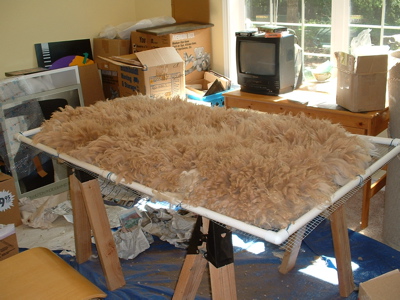
(I’ve since moved the whole operation to the garage). It is made of PVC pipe and 1/2 inch hardware cloth and duct tape. I have lost the “plans” but basically, you need a frame of about 3’ by 5’ of either wood or pipe. Then you need to attach the 1/2 hardware cloth to it. Hardware cloth is wire mesh, and 1/2 inch holes will allow dirt, poop and some second cuts to fall through. Then you need to set it up on legs or sawhorses. Over the years, I’ve added duct tape to the edges of the cloth to keep it from snagging fiber and an anti-fatigue mat so I don’t get so worn out standing on the concrete garage floor.
That’s all for now. Next time, we’ll talk about how to skirt a fleece!
 Dawn's cria was born on July 15, 2009. She appeared in the pasture about 12:30 in the afternoon, a nice surprise.
 Here is a group shot of Canyonera (a few days), Margie (22 days)and Apu (almost 4 months).
 Click on the chart to get a bigger view of it.

 Manjula, June 22, 2009
 Manjula, June 25, 2009


 Here's the best shot of Lisa that I could get today. She is a big alpaca with lots of fleece, but you can see that she's also heavily pregnant.
 Here is Lisa the chow hound. She's the one who overturns the hay bins and eats the bottom hay.
  Apu is home!
 I like this shot, though we've fixed Julius's ear.


 She likes sunning her tummy when the weather's nice. It's just that there normally isn't so much of it!

The national Alpaca Registry Inc., in Lincoln, Neb., says registrations are on pace to rise 7% this year and currently stand at 140,297. Ms. Parks says a female of "medium quality" can fetch $10,000 and that prices have been rising, supporting her hopes that she'll see a profit on her alpaca portfolio in five years."
I'm interested in the idea that alpacas are seen by some as a sounder investment than stocks. I don't think I would go so far as to recommend people by alpacas as their sole investment. However, they are far cuter than most portfolios, and have a long track record of increasing the value of their herd (by reproducing).
I think it's great. I love front-page advertising.
m


That's enough for now. I'll have pictures of shearing and the show later.
m


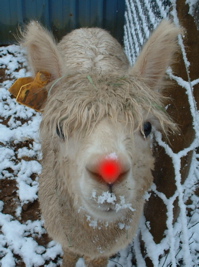
Hello everyone!
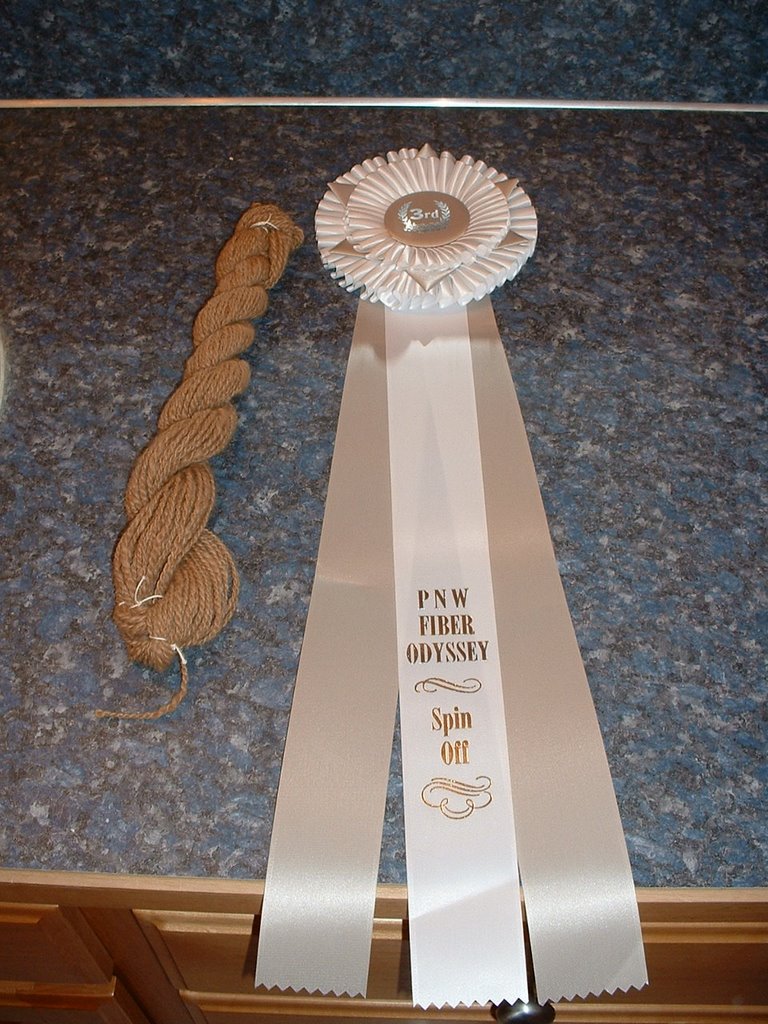
We have had a productive year entering alpaca fleeces in fleece shows. Bart and Duffman have each won one fleece ribbon, but Milhouse has won two, including third place out of a class of fourteen in a spin-off competition. We are very proud.
Merry Christmas and a Happy New Year!

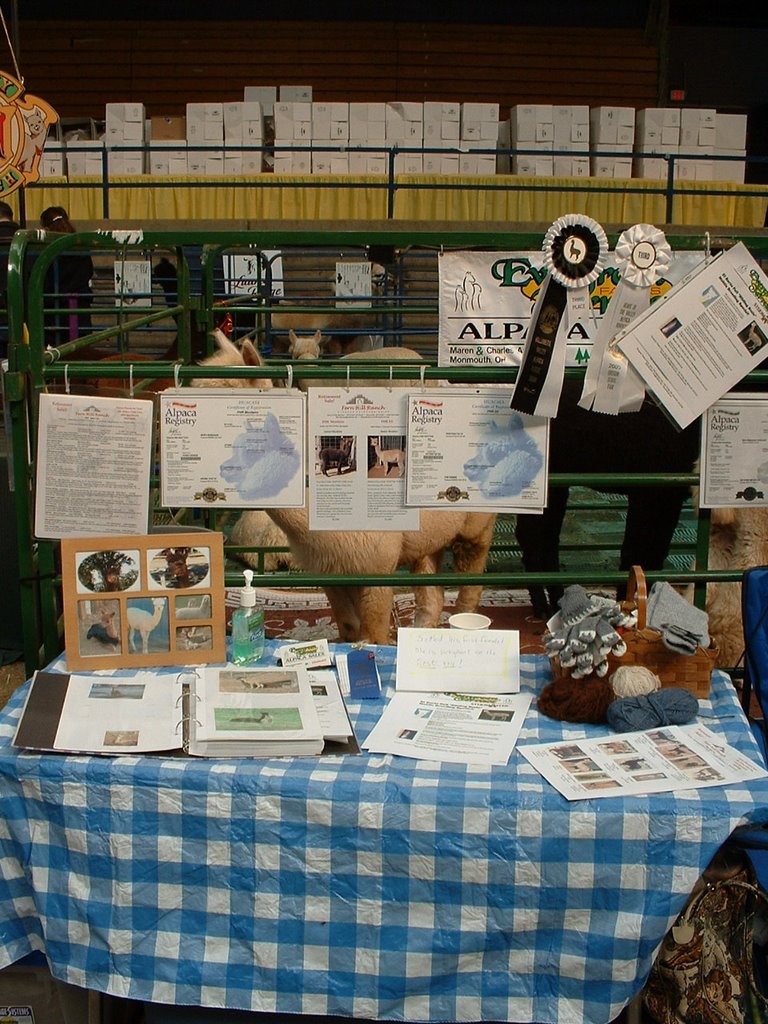
 It turns out that Eli, who was scared spitless the entire show, was the one who won a blue ribbon. The judge was very impressed with his "showmanship," which floored me. I didn't even think he was talking about us as he went on and on about how well this animal was showing, etc.
 Duffy ended up with a fourth place ribbon out of four, even though his testicle was nowhere to be found. The judge was very kind about giving us a ribbon for what can be a disqualifying fault.
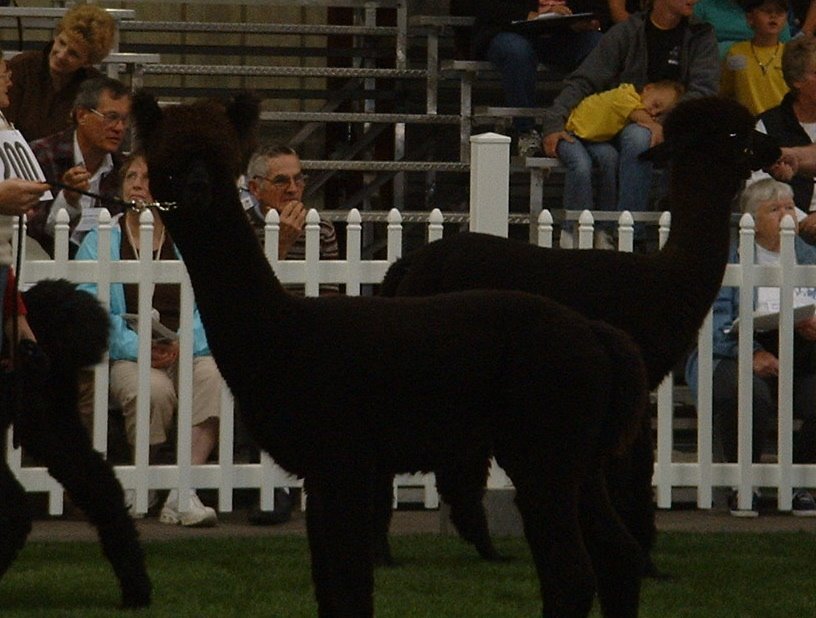 Monty didn't get a damned thing, which was the biggest surprise of the show. However, it was understandable. He was in a class of thirteen, all but two of which were older than he. They were all lovely, and the first and second places were won by near-two year olds. It was disappointing. However, I have never seen such a strong class of black animals.

 Posts
All Comments
Posts
All Comments


